
The last mile between rich web content and everyday action
Website Companion brings progressive programs, protocols and task lists to mobile devices – with offline access, locally stored progress and timely notifications.
The problem
A website can explain a complex process beautifully, yet still leave the reader to remember where they are, find the right page each day and work out what applies now.
Native apps solve parts of that problem, but separately rebuilding publisher content creates duplication, drift and slow release cycles.
The goal
Let websites remain the source of truth while a generic mobile companion handles the parts phones do best: offline access, local progress, recurring tasks, native interactions and notifications.
One authored experience, four clear stages
1 · Publish
The website remains the content authority.
2 · Sign
A declarative, versioned package is cryptographically signed.
3 · Connect
The mobile app verifies and downloads the experience.
4 · Do
Progress and reminders stay on the user’s device.
What the mobile experience adds
Progressive guidance
Unlock steps over time, retain earlier active tasks and always show what applies now.
Everyday scheduling
Anchor task groups to wake, meals and sleep, with user-controlled reminder times.
Offline continuity
Keep previously verified content available when the website or connection is unavailable.
Grouped notifications
Send one useful reminder for a daily group rather than overwhelming users with item-by-item alerts.
Publisher-controlled presentation
Refresh content, structure and branding without requiring a new app release.
Local state
Choices, completion history and notification preferences stay on the device.
SIGNED CONTENT · LOCAL PROGRESS · PUBLISHER-CONTROLLED · OPEN INTERFACE
A deliberate trust boundary
The app verifies publisher signatures before accepting a package. Website content remains read-only, while choices, progress and reminder settings remain on the user’s device. The public contract does not provide an interface for uploading that state.
If a user chooses to open an external website, that website’s own privacy practices apply separately.
Example: a 10-week bodyweight consistency challenge
A simple challenge begins with one daily bodyweight exercise. Each week unlocks one additional exercise while the earlier exercises remain active.
On the website
The publisher authors ten progressive weeks, daily task groups, concise instructions and a presentation bundle.
On the phone
The user sees the current week, earlier active exercises and one grouped daily reminder at a time they choose.
What it demonstrates
Progressive unlocking · cumulative tasks · grouped reminders · daily reset · offline use · automatic refresh · local-only progress
The signed example is live. Use the QR, clickable connection or copyable discovery URL below.
INTERACTIVE EXAMPLE
Connect the ten-week challenge
Scan with your phone camera, or open the same connection link on your phone. The connection identifies this publisher and experience; it does not contain your answers, progress or reminder settings.
Discovery URLhttps://joshualeisk.com/.well-known/website-companion.json

TRY THE SAME EXPERIENCE ON THE WEBSITE
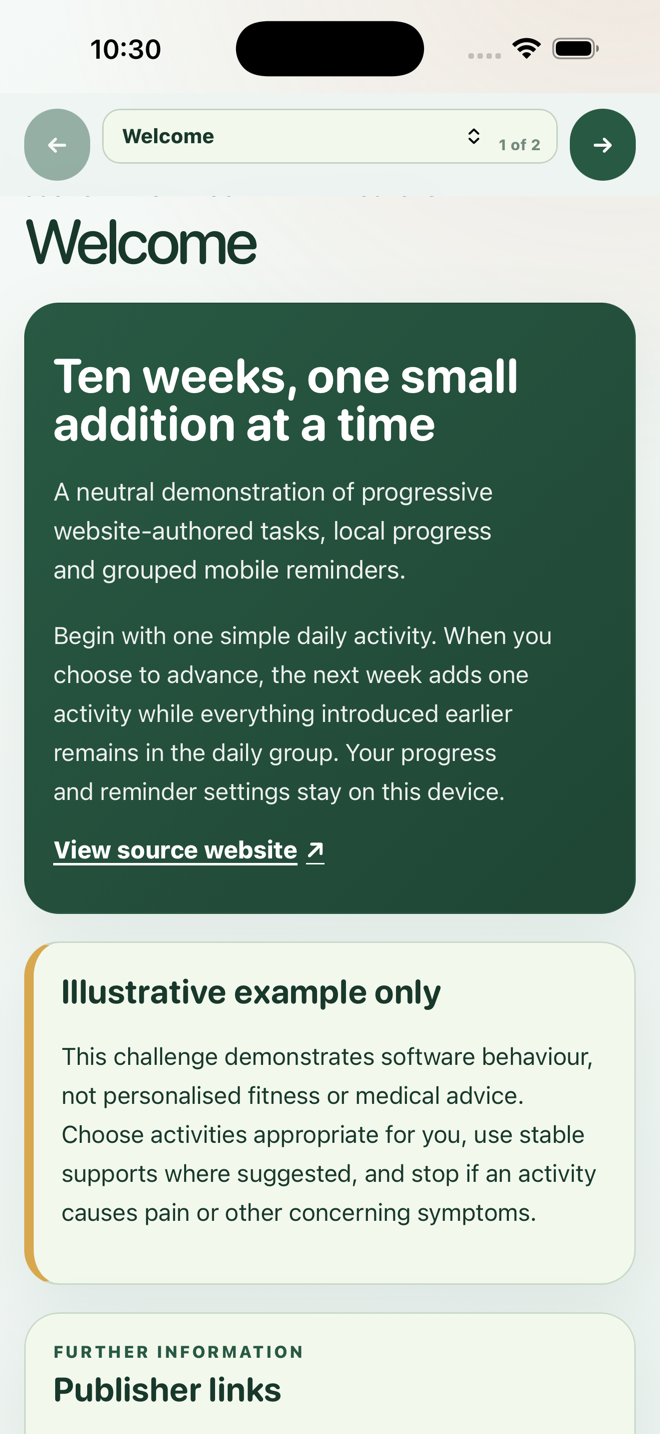
Ten weeks, one small addition at a time
A neutral demonstration of progressive website-authored tasks, local progress and grouped mobile reminders.
Begin with one simple daily activity. When you choose to advance, the next week adds one activity while everything introduced earlier remains in the daily group. Your progress and reminder settings stay on this device.
Week 1 of 10
Week 1
This browser demonstration stores its selected week and daily ticks only in this browser. Scan the QR or open the connection to begin separately on your phone.
This challenge is an illustrative software demonstration, not personalised fitness or medical advice. Participants should choose activities appropriate for them and stop if an activity causes pain.
For publishers and developers
The interface uses HTTPS discovery, declarative JSON resources, Ed25519 signatures, immutable content versions, cache validation and a bounded component model. Packages contain publisher data and presentation, not downloaded executable website code.
The public repository contains schemas, an OpenAPI description and neutral conformance fixtures so the interface can be reviewed independently of any one publisher.
Project status
Website Companion is available now, free for iPhone on the App Store. Android availability is pending while Google Play organisation verification and publication requirements are completed. The public interface and interactive example remain available for publishers, developers and anyone who would like to explore the project.